Boston’s Marathon Monday was a blast as always! Last marathon Monday, I was impressed by the motivation, perseverance, and all-embracing sports spirit of the event both in the face of the  professional athletes and the jogging enthusiasts (read my previous article). This year, I had an even more active role in the Marathon celebrations as part of a group of wild Boston University fans.

Marathoners running up Beacon towards Kenmore Square under the scorching sun and a storm of cheers from the crowd

Let’s face the truth: the Boston Marathon would not be the same if it weren’t for the crowds of fans cheering, shouting, applauding, whistling, singing, ringing bells, drumming drums, high-five-ing, and blowing kisses at the runners.

The task of a Boston Marathon true fan is, therefore, a major responsibility. It begins a few days before the big day with drawing posters with silly slogans such as, and I only quote things that I’ve seen with my own eyes “You’re Almost There! That’s What She Said”, “The Guy In Front of You Farted, Run Faster!” and “You Got Stamina. Call Me: 7138596113.” On the weekend before Marathon Monday, the devoted fan has to also stock up on alcohol and snacks and find a place to party (be sure to make these arrangements in advance because someone told me that Blanchards, the big alcohol store near BU, was completely depleted and had to close early on Sunday).

On Marathon Monday, the true marathon junkie wakes up very early, around 7 or 8am, puts on brightly-colored running gear, and goes to a “kegs and eggs,” which, as I learned today, means to have breakfast while getting drunk or vice versa. Our breakfast of champions consisted of casserole, muffins, potato chips, sangria, bloody marry, Corona, Sam Adams, whiskey sour, and ouzo (a nice Eastern European touch on my side,  I thought).

The best locations for Marathon parties are of course along the race’s route – Beacon Street, Kenmore, Commonwealth Ave. It’s OK if you don’t have an apartment with a balcony overlooking the street like we did (hehe) because many people just bring their barbeque and boombox outside and party on the sidewalk all day. 

Some of the common sights throughout the day are: college kids dressed as Teletubbies, frat boys waving pirate flags, BU Resident Assistants chasing students off the roofs of campus housing, the BU police sniffing the content of every “water bottle” being carried around.  The best part of watching the race is chanting  “You can do it, 6472!” or “USA! USA!”  as the runners start arriving.

Let me just mention that this year’s marathoners had to deal with record high temperatures (about 30C), so the event was especially emotional – total exhaustion plus dehydration for some, and drunkenness plus sunstroke for others.  Around 2 o’clock, just at the peak heat, the most faithful marathon groupies could not resist and jumped the enclosures to join the runners for their final two miles. One of my friends even crossed the finish line in her flip flops with a red solo cup in hand. Thinking that she was a real runner, a very committed medical volunteer hurled her into a wheelchair and tried to treat her. Later, my friend told me that in the jam of wheelchairs around the medical tent near Copley, all she could see was a sea of sunburned and flushed, but very, very happy faces!

Fans dressed like for a jog - but only to show support, absolutely no intention to run for real!

Stairs and balconies offer the best vantage points, plus they are conveniently located next to the grill and the cooling bag.

This important artifact during the Boston Marathon celebrations, the Red Solo Cup, is also a staple in the American college culture.

Alas, I got distracted eating the chocolate eggs that my American roommates’ parents sent last Sunday and (for a fourth year in row) forgot to paint some eggs for my own Easter! (Bulgarians are predominantly Eastern Orthodox Christians and celebrate Easter together with the Greeks, Serbs, Romanians, Ukrainians, and Russians. This year, our Easter is on April 15th)

So instead, I decided to post a few beautiful photos of painted Easter eggs. Enjoy!

The way you make these patterns is by wrapping a leaf around the egg using a stocking to hold it fixed and dipping it in a jar of food paint

The way you make this pattern is by pouring different paints in a piece of cotton and wrapping the egg in the cotton. It looks like a colorful cloud, doesn't it?

These you make by "painting" lines and shapes with a candle and dipping the egg in the paint. There will be white lines where the wax touched the egg. Coat the color with wax and dip the egg in another color to add more layers to your painting. Bravo, Picasso!

Leaving the religious significance of this day aside, Easter is one of my favorite family holidays! Read more about my family’s celebrations here. The whole extended family gets together for a huge party. The centerpiece of the feast is the whole slow-roasted lamb and my grandmother’s amazing traditional Easter sweet bread with rum and dried fruit), kozunak (see a recipe).

The most fun part of the day is the egg fights (read my instructions) where you duel with painted eggs – the egg that survives without a crack is the champion!

How did you celebrate Easter this year?

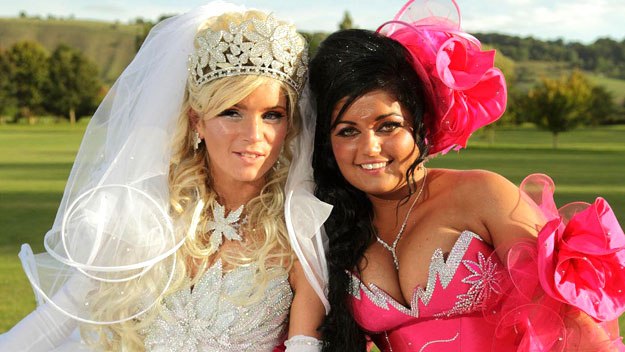
And speaking of the “Gypsy Nightingale” Sofi Marinova To Represent Bulgaria in Eurovision 2012, I recently stumbled upon a very interesting documentary series from the UK, Big Fat Gypsy Weddings.

The series follow several gypsy families as they plan their daughters’ weddings and offers commentaries about this ethnic group’s traditions regarding interaction between the genders, family values, educating the youth, choosing a house, and so on. The 5-episode series aired for the first time in 2011 on Channel  4  ( on TLC in North America under the name My Big Fat Gypsy Wedding). The second episode got 8.7 million viewers, giving Channel 4 the highest ratings since Big Brother. Check out the series on YouTube:


The show distinguishes between Irish Traveler and British Romani Gypsies. What is fascinating to me is that these two communities seem completely different from the Easter European gypsies. So I made a little investigation:

There are three types or lines of Gypsies that emigrated from their land of origin in today’s Pakistan during three exoduses in the period 1000-1400s AD: Domari, the Egyptian and Middle Eastern Gypsies; Lomavren, the central gypsies of Armenia and Turkey, and Romani, who made their way to the Byzantine Empire, through the southern Balkans (Romania, Bulgaria, Serbia, Moldova, Hungary etc) and now populate all of Europe. The Gypsies have always been a semi-nomadic cultural group with their own language (and sixty dialects) and religion.

The Irish Travelers, which the TV series also focuses on, on the other hand, are not from the same Indian ethnic origin as Gypsies, but they share a similar nomadic background and do not mind being called Gypsies. Travellers are of Irish origin, populate Ireland, the UK, and USA, and have their own language and traditions, but are often put under common denominator with Gypsies because of their similar lifestyle.

I personally had never seen Gypsies in the light in which Big Fat Gypsy Weddings present them!  There seem to be striking differences between the living conditions and lifestyles of Western European and Easter European gypsies. On one hand, this is normal because there are such differences between Western and Eastern European countries in general. On the other hand, it really disturbed me to see that even the most ostracized and marginal community in Europe seems to be so much better off in  the West than in the East.   

The TV shows portrays Gypsies (Romani and Travellers) as a group with ostentatious sense of fashion, yet a very conservative worldview that is driven by a very strict moral code. UK gypsies may be over-the-top and hardly compatible with the “settled community”, but their culture seems fascinatingly rich. Thus,  UK Gypsies seem worlds apart from Eastern Europeans gypsies.  

The majority of Bulgarian and Romanian gypsies  live in poor conditions in the outskirts of the cities or in very poor villages (there are exceptions of course). In the countryside, their main occupation is shepherds or day-laborers. In the cities, they often collect metal for scrap, clean cars at traffic lights, beg, or pickpocket.  None of the Gypsy slums I have seen in Eastern Europe look like the nice houses portrayed in the British series. Like in the UK, Bulgarian gypsy families are large but mainly because girls give birth at a very young age and have many, many children.

Regarding their sense of style, I have never seen Bulgarian gypsies dressed as flashy and colorful as the Travellers in the UK in their daily life (except for a wedding, as the video below demonstrates).  Our gypsies usually wear clothes that they find or that are given to them, or very cheap clothes sold in bulk – so they look more like shabby street urchins than like provocative fashion divas. They would rarely be able to afford buying new dresses for each wedding they attend like their UK counterparts. Our gypsies do, however, put on make-up sometimes and often bleach their hair – and this applies both to boys and girls. Therefore, in Bulgaria we have a saying “dressed as a gypsy”, which might mean very scruffy and ragged, but might also mean  flamboyant to the point of looking ridiculous.

Bulgarian gypsy weddings are, similarly, a great celebration for the community, but in a very different, much less glamorous way. They usually include an orchestra (often times with a dancing bear), the entire village/neighborhood as guests, and a lot of bargaining and arranging the marriages of the next daughters in line. Compare this video from a Bulgarian gypsy wedding (notice the surrounding – this is the gypsy quarter in Stara Zagora) to the UK series and tell me what other striking differences do you notice?

***

You Might Also Find Interesting: 

On The Gypsy Riots in Bulgaria from October 2011

Goran Bregovic Plays for Balkan Unity in Sofia

Gypsies in Sofia: FUNNY PICTURE

The Bulgarian English Wedding

The Polish Bulgarian Wedding,  Or Who Can Drink More: Polish or Bulgarian? 

When Marriage Stops Seeming So Far Away

The Gypsy Pearl of Bulgarian Pop-folk, Sofi Marinova, will represent us at Eurovision 2012

My favorite time of the year is coming closer! It’s time for Eurovision 2012, the pan-European music contest! It has been such a roller coaster for Bulgaria in the past six years!

We were on the way to greatness in 2007 with Elitsa and Stoyan Yankoulov (with were fifth woohoo!); then in 2008 I was sort of positive about Deep Zone coming up with their very catchy “DJ Take Me Away”; I had to close my eyes in 2009; in 2010 I put all my fate with my all-time-favorite Miro, and then in 2011 I was hoping that the European voters with find Poli Genova at least cute, but now…   now, I’m simply desperate by our choice of representative.

Bulgaria’s 2012 Eurovision contestant is Sofi Marinova with “Love Unlimited”. Don’t get me wrong, Sofi Marinova has an amazing voice and her songs become instant hits, but I think that this one is simply not one of them. Plus, her singing and image are… how can I put it… too Bulgarian for the average European taste (remember, the whole of Europe will vote for their favorite singers in the contest). But Sofi Marinova was elected during Eurovision’s national level finals on Feb 29th. She competed against 12 other Bulgarian singers and earned her title via a combination of jury and viewers’ text message votes. As you can tell, we Bulgarians love our gypsy chalga rhythms.

Sofi Marinova, also called “the gypsy pearl” or “the gypsy nightingale”, is a Bulgarian pop-folk singer of gypsy (Roma) background. She has a phenomenal 5-octave vocal range and is one of our top chalga singers. In her personal life, she is notorious for giving a son to her husband, then divorcing him, and getting with this ex-husband’s other son… but she’s cool otherwise :)

Instead of showing you her Eurovision song, I’ll show you my favorite duet of Sofi and Ustata . Of course, it’s a typical chalga video with very intelligent lyrics:

I don’t think she will reach the finals, but I’ll be crossing fingers anyways! Eurovision 2012 will take place on May 22, 24, and 26 in Baku, Azerbaijan.

*

More on Eurovision and Chalga:

Eurovision 2011: Poli Genova Urges Young Bulgarians to Stay

Bulgaria’s Heart Breaker Miro Will Compete in Eurovision 2010

Sex and Watermelons in Bulgarian Pop Culture

BBC Close-Up: Bulgarian Pop Folk

During the first days of spring, I ironically had one of the windiest, coldest nights of my life in Vermont. As my shoulders were starting to throb with pain under the pressure of the beating wind, my fingers were turning blue and then becoming numb, and my brain was getting frostbite, all I could think about was ice cream.

Winter hat and ice cream? Never in Bulgaria - that kid will catch a cold!

In Bulgaria, I wouldn’t eat ice cream until probably mid-June, and then only until the end of August. Why would you eat something that cold unless it’s really hot outside and you are at the beach or outside in the sun? In the States, ice cream is maybe the number one dessert – everyone has at least one box of it in the freezer, and there are numerous ice cream parlors that are open and busy at any time of the year.

Ice cream (and the latest trend, frozen yogurt) is such a staple in the diet of the average college student here in Boston– it’s a treat, it’s midnight snack,  it’s comfort food, it’s exam time food, it’s after-party food. In wintertime or summer, there is always an occasion to get a cone at Ben & Jerry’s, J. P. Licks, or Emack & Bolio’s, and what is more – to eat it outside in sunshine, rain, or snow!  There is seasonal variation in the volume of sales of course, but it sort of evens out for the ice cream producers since they sell more cones through their outlets in the summer and then more boxes for home consumption through supermarkets in the winter.

We don't have sundaes or brownies/cookies with ice cream, but we love our melba - a fruit cup with ice cream, biscotti, and other goodies!

My excuse for my ice cream ignorance is that I’ve always thought that you can become ill from the cold. It’s just something that every Bulgarian mother tells her kids – always sleep under a blanket or bed sheet, never stand where there is wind current, don’t sit on the cold pavement, don’t drink chilled Coca Cola with ice too fast, and don’t even think about ice cream when it’s cold outside! (Mind you, chilled beverages in Bulgaria come with three ice cubes at most! There is none of this fill-up-my-glass-with-ice-and-sprinkle-some-beverage-inside that you get at American restaurants!) Also, the most vital body parts that you should never expose to wind or cold are your waist (because your kidneys and especially the ovaries might get sick), your head (I would guess because of the brain), and your feet (because it just sucks to have cold feet?).

My Russian professor said that it was the same in Ukraine and Russia:  they also believe that you can “catch a cold from the cold” and that ice cream is only for the heat of summer. On the other side of the spectrum, there are some cultures that drink hot tea when they feel the hottest in order to cool off! What do you think, is the idea that cold can bring you diseases just an Eastern European superstition or is it wisdom?


Other Articles Related to Superstitions: 

Spitting on a Baby Protects in From the Evil Eye

Lucky Like a Chimney Sweeper

H.C. Andersen’s Mermaids and Slavic Samodivi, Folktales of the Spring


Background: Spring break is a week in late March or early April when all universities in the US give off. This is the time when all underage American college students flock to Mexico, the Bahamas, the Dominican Republic, Jamaica or Puerto Rico and (completely legally) pass into drunken oblivion for the duration of the vacation. The most visited attractions during the break include booze cruises, bar hopping tours, and beach raves. The large majority of students come back from Spring Break with face piercings, shaved eyebrows, tattoos, or STDs. The most frequent ways of describing the Spring Break experience are “whatever happens in (insert location), stays in (insert location)” and “shit went down”.

I thought for me, a calmer trip to a relaxing tropical US destination was in order this year, so I decided to visit my good friend in Miami, FL (read about our trip to Disney World). As it turns out, Miami was very well prepared for the Spring Break invasion.

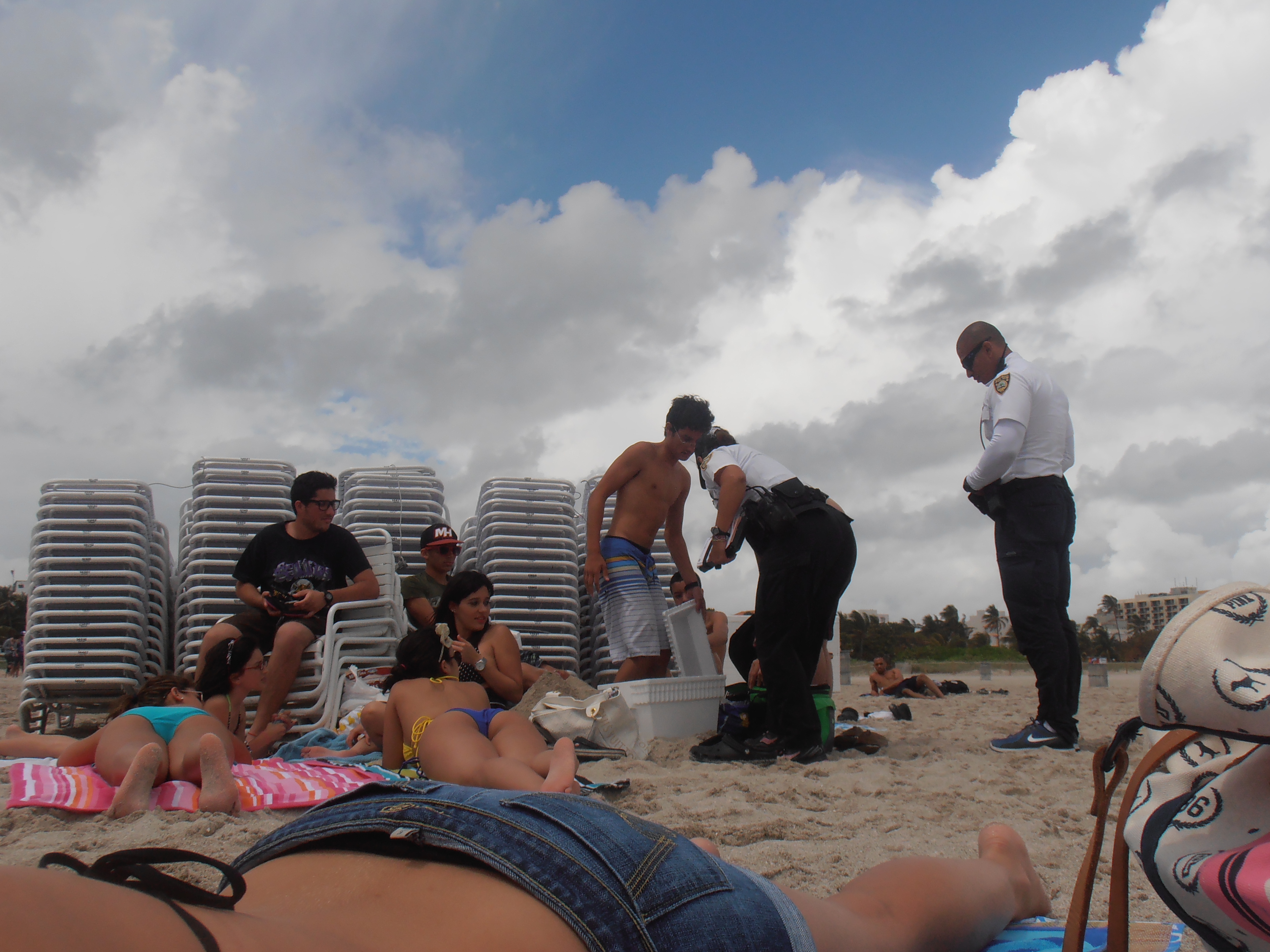
During the day, we were sunbathing in South Beach literally under the surveillance of a squad of policemen. They were walking up to every single beach towel or lounge chair and looking around for open containers, illegal substances, or suspicious behavior. It was hilarious that they were all dressed up in uniforms and equipped with truncheons and handguns under the scorching sun while the vacationers were chilling or fooling around in the sand. I’m not sure if I felt secure or amused by the police’s presence.

Miami police scrutinizes spring-breakers on the beach

Busted with an open container!

Cool Nike-s, officer!

Now I feel safe at the beach!

I also noticed that open containers are forbidden outdoors in South Beach. However, smoking is allowed in clubs and bars. In the same time, it is illegal to sunbathe topless on the public beach in Miami, so people have to go to special adult pools to enjoy that privilege.

The beach in Miami is also very wide and without any buildings on it. Ocean Drive and the beach bars are very far from the shoreline, and so are hotels. In contrast, the Bulgarian shore at our top resorts Sunny Beach and Golden Sands is scattered with beach bars that blast techno day and night or lounges with white cushions where you can grab a mojito or a bowl of watermelon and listen to some chill out music. As cool and fun as our beaches are, our bars and hotels unfortunately eat up a lot of the beach, and thus force many people to look for alternative, uninhabited beaches. Fortunately, in Bulgaria you can always drink alcohol and go topless at the beach (and not only there)!

A wide white beache in Miami

The beach in Lozenetz, Bulgaria is occupied by hotels, beach bars and lounge chairs

At night, Miami seems even more like a CSI episode. The police had cut off one lane of a street and were making every single car go through a DUI check (driving under the influence is a very, very major offence in the States). The officers were pulling over certain cars and going through them with a detection dog! As my friend, a University of Miami law student said, such random search operations are completely anti-constitutional, and the criterion for pulling a car over is that the driver looks Latino or black! But then again, I guess in Miami it feels like Spring Break all year long, so maybe all this police presence is justified!

***

You Might Also Enjoy: 

You Are Too Young To Go To Sunny Beach

Armin Van Buuren at Cacao Beach

I’ve never written a post about America’s weight issue because I think that too many people have written about it, and also it hasn’t ever particularly bothered me. Yes, I have seen more obese people (both in number and in size) here than anywhere else in the world, and I think we all know what the reasons are. But I’ve noticed that the biggest health freaks are also American. Anyways, this post is not about fat people but about fat people in wheelchairs.

It was nice to see that Disney World was very accessible to people in wheelchairs. But then I realized that these weren’t really wheelchairs but more like automatic chairs that wheeled healthy-looking people around. Eh, healthy is not the exact word. These were people who are not disabled but have trouble walking because they are obese… or as my American friend put it, because they are “lazy fat Americans”. Ouch!

Did you see that Pixar movie WALL-E where the post-apocalyptic humans move around their city in automated gravity-defying armchairs and watch life from their plasma screens while munching on burgers and milkshakes? Yep, that’s almost what I saw in real life!

Can someone explain to me why did those people use wheelchairs?

When I first went to Disneyland Paris more than ten years ago, I thought I had woken up in a fairytale.  A few years later, when I visited Disney World Orlando, I once again felt like I was being transferred into the land of magic.  I recently visited Orlando twice more as an adult (more or less), and I still felt completely entranced by the place. Disney World truly is an enchanted factory for happiness. I wish more cities could learn from the amusement park’s practices and implement them to make our living environment a little bit more pleasant.

Parents and kids burst out singing and dancing together with the actors on Main Street

What makes Disney World so magically perfect is the attention to detail. Every lamp post has a tiny little ornament, every bench leg has some sort of embellishment, every fence or grating has a little twirl or swirl that makes it look intricate and beautiful. Buildings under reconstruction are covered with panes that display what the façade will look like and pipes or technical equipment are hidden under beautiful covers that resemble bushes or rocks. Such details can make the most mundane or unattractive objects look delightful to the eye.

I wonder if the actors smile for pictures behind the masks?

I remember from ten years ago my mother’s astonishment at the perfect Disney pavement. There is not a single pothole, not a single chipped paving-stone in any of the kilometric alleys. The drainage system is constructed perfectly, so rain water seemingly washes away without forming puddles by the sidewalk. In Sofia, they pave and repave the streets every single summer, but they just don’t do it properly, so cobblestones get pulled out or asphalt cracks up and forms potholes. In Disney you do something once, but you do it at the highest quality and then maintain it.

A sea of strollers inside the theme park

What impressed me even more that some of the attractions is the order put into action in the park. Hundreds of people wait in queues at any single moment, but there is never pushing or cutting in line or any tension. Unobtrusive enclosures form very long and narrow lines that meander in front of the attraction’s entrance, so people slowly move forward in a row of one or two. A clock shows you the estimated time of waiting, which again tells you what to expect and alleviates any negative emotions associated with the wait. Moreover, waiting in these lines is enjoyable because there is music and themed sculptures or interactive screens around you. There is also a system for avoiding the wait – get a “fastpass” now from a machine by the entrance and come back in a few hours at the indicated time, and you will get through the fast lane. I hate to remember how I have to wait for hours when I need to get some administrative job done in Bulgaria in a line that is more like a crowd of aggravated people trying to cut in front of you to reach the single window/desk/counter where the bored bureaucrat sits.

Perfect decorum while waiting in line

The service in Disney, naturally, is impeccable. My friends and I were wondering how is it possible for someone to smile so much. Surely, the dancers, performers, waiters, attractions assistants, actors dresses up as characters, and tour guides, cannot possibly be always in a good mood, but they know that the visitors want to see only happiness during their vacation, so they make sure they play their part accordingly. I was also wondering, do the actors who wear big fluffy costumes with masks smile during photos? My answer is, I am sure they do! Because although the actors are just doing their job at that moment, the joyous smiles on the faces of the kids (and the grown-up kids) surely evoke reciprocal feelings in the actors.

No wonder why everyone lives their dreams in Disney World

And speaking of kids and families, it is funny how much Disney caters to parents in addition to children. With all the crying babies, whimpering toddlers, and sniveling teenagers, a vacation at Disney could soon turn into a nightmare for the parents! So there are huge parking spaces for strollers inside the park for parents’ convenience, a special menu for “little princesses and princes” consisting of macaroni & cheese, peanut butter & jelly, and chicken nuggets (apparently these are American children’s favorite foods?!) at every restaurant, and even a lot of “cooling stations” where you can enjoy tiny water droplets being sprayed on you when the Florida heat becomes unbearable.

Finally, Disney’s fireworks are more magnificent than my capital’s on our national holiday! Disney World has mesmerizing fireworks shows in two of its parks (Epcot and Magic Kingdom) every single night all year round. This makes it the second largest purchaser of explosives in the United States. Unquestionably, Disney knows how to make magic come to life!


***

You Might Also Enjoy:

Bureaucracy in America: Iron Policy of No Compromise

My New Adventure with American Institutions: Social Security


It is a widely accepted idea that while Americans are comfortable with displaying violence, they often shy away from eroticism. In most places in Europe, things are reverse (except for in Britain, where they sort of look shun away from both).  In the States, this offers a great business opportunity for stirring the spirits and attracting attention by means of … showing some flesh.

Hooters girls look innocent compared to...

A great example is Hooters (hooter: 1. one that hoots, especially an owl; 2. slang for a woman’s breasts). It’s a casual beach-themed bar/restaurant with over 400 outlets in 44 states and 28 countries. The signature Hooters offerings are the spicy chicken wings, the sports on television, and the girls in scanty white-and-orange uniforms. 68% of the clientele is males, mostly in the age bracket 25-54.

Hooters greatly benefits from the scandalous use of sex appeal that the Hooters Girls are known for: the majority of American women claim that the name of the restaurant and the waitresses’ uniforms are degrading. Still, the restaurant and its huge fan base retort that the girls are as socially acceptable as any cheerleader or swimsuit model.  What is more, the “attractive, vivacious” Hooters Girls are the businesses’ staple according to its mission statement and have allowed Hooters to extend its brand with a Hooters Calendar, merchandise and apparel, and various sports events sponsorships.

...Bulgarian chalga singers and pop idols Andrea and Galena

The reason why Hooters is so notoriously successful is that as a hole, Americans are very conservative and this restaurant is one of the few places where men can commit some “socially acceptable” sins – get drunk off beer, overeat with wings, and hoot a little bit at the young girls. In fact, this is as scandalous as it can get in an American public establishment.

The reason why this restaurant concept will not work in Bulgaria is that it is way too innocent for us! In a country where the difference between the porn channels and the music channels is only in the sound, and where the ideal of beauty involves silicone, botox, and bleach blonde hair, the Hooters Girls will simply blend in (or even look way too sporty). It is very sad that Bulgarian pop culture has been completely taken over by the pop folk (chalga) singers who have plenty of sex appeal, but little other talents. And while the Hooters Girls stay within the confines of the restaurants, our distorted perception of silicone-beauty spills over everywhere: among the highlife, in the nightclubs, in cafes downtown, in the malls, and in high schools.

Read more about Bulgarian chalga pop culture:

Sex and Watermelons in Bulgarian Pop Culture

Throw Napkins in Clubs in Bulgaria and Dollars in the Bahamas

BBC Close Up: Pop-Folk in Bulgaria

My next goal in life: create the best country branding campaign for Bulgaria!

But until then, let me show you what one of our favorite neighbors, Serbia, came up with their 2011 campaign. This marketing campaign puts a very innovative twist on country branding. Instead of focusing on historical, natural, and architectural sites as most such promotional videos do, Serbia has chosen to focus entirely on food.

They are very smart to do so because the Balkan cuisine is one of the most delicious in the world (I’m being objective here, honestly)! And although most of the foods they present here are common to several Balkan countries, Serbia has succeeded in personalizing this spot and making it feel unique. My only little critique is that I wish they had put typical Goran Bregovic rhythms in the background!

The message of the video is very clear: Serbia has great food produced in a clean, sustainable way. The country is heaven for those seeking an authentic food experience, village tourism or bio tourism. The simplicity of Serbian (and Balkan) cuisine is what makes it so tasty: fresh, natural ingredients that are full of flavor, juices, and aromas.  Notice that the spot is focusing on the ingredients themselves rather than the meals that can be prepared with them: so once again, it’s about the simple pleasures in life… in Serbia.

This promo video is a delight to the eye, to the taste buds, and to the soul, and I hope it attracts many tourists to Serbia!

… But, as I was looking through some forums regarding the above video, I came upon another promotional video, this time from out other beloved neighbor, Macedonia. The two videos, unfortunately, are surprisingly similar. The Macedonian one is from 2010 and once again represents a journey through the country as a journey through honey, wine, succulent meats, and enticing spices. The voice over says: Македония, мала земя, голема храна. Македония, вечна. – Macedonia, small country, great food. Macedonia, timeless.

Eh, what can I say… I guess we on the Balkans are not so creative after all… Which video do you like more?

You might also enjoy:

Branding Romania: Creative Ads

Bulgaria: Magic Lives Here. The campaign the whole nation dislikes. 

Socialism Sells: What makes Soc-themed ads so successful in Bulgaria

Dimitar Berbatov, The Brand

Back home, only security forces and criminals have guns. In Texas, shooting is a family activity! And presumably the Balkans are the scary place!

My vacation in Corpus Christi, TX included an afternoon at The Sharp Shooter, one of this seaside resort’s many shooting ranges.

At the Sharp Shooter, anyone above the age of 21 can buy, sell, and trade their handguns and rifles. Anyone without restrictions can simply come and shoot for fun! There is no legal age for shooting, which is why the Sharp Shooter offers a great promotion, I quote:

 Family Day on Sundays: Children (16 and under) shoot for free **With paying adult.** Bring the whole family and save.

I guess shooting has a family bonding role in Texas, just like playing monopoly or riding bikes in the park. It is also a completely gender-neutral activity, check this out:

 Ladies Day – Tuesdays: Women shoot for ½ price. They also enjoy free targets, eye and ear protection, gun rentals, and classes from our expert instructors.

These instructors, by the way, were very kind Texan men who gladly showed me their entire line of guns: Taurus, Remingtons, Weatherbys, Smith & Wessons, Brownings, Springfields, etc, including the “cute” pink mini pistols, which are “ideal for a lady like you”.

In Texas, you do not need a permit or license to buy a gun or rifle; you don’t even have to register as an owner. You, however, need a permit to carry a concealed (out-of-sigh) handgun, which you can easily obtain at the gun store in exchange for an application, two color passport photos, fingerprints, and proof of residency and age, and $125. Once you’ve got that document, you can tuck your gun in your belt, put your shirt over it, and carry it whenever and wherever you’d like. Still, some establishments such as bars, schools, hospitals, and amusement parks put up a sign at the door saying that you should leave your gun in the car.

You are permitted to carry your gun out in the open if you are on your property (which explains the movie scenes where an old lady pulls out a rifle from underneath her skirt and points it at the intruder in her backyard). You can also openly carry your gun while you are hunting, attending a weapons exhibition, practicing at a shooting range, or all similar “sports” activities, which would probably be illegal in most countries.

When in Rome, do as the Romans do, I said to myself, and shot a few times at the target with my friend’s rifle and guns. But still, I had a hard time understanding why my guy friends, who had just moved to Texas, had suddenly all bought a gun (or more than one, or even a whole collection of them). Even the greatest pacifist among them said he wanted to buy a taser (the thing that shoots up a metal rod in your skin and shocks you with electricity!).

“Everyone here has a gun,” the boys said, “so it’s a question of safety to have one as well.” I can’t say that I felt very safe having a burger in Hooters on a table with six guys, at least two of whom were carrying a concealed gun at that time. Kill me, I don’t get the logic (pun intended)!

What do you think? Is it ok to make guns so widely available and widely acceptable (to both children and adults)? What does this say of the American society, which has become so used to the presence of guns and violence that they don’t find it disturbing anymore? 

You might also enjoy:

Adventures in the Lone Star State: Selena and the Tejano Culture

Adventures in the Lone Star State: Texas Pride

In Texas, I saw the biographical movie Selena, and it helped me understand the Tejano culture.

Selena Quintanilla-Perez, The Queen of Tejano Music

Selena Quintanilla-Perez (1971 – 1995) was a Mexican-American singer also known as the “Queen of the Tejano music” and the Mexican equivalent of Madonna. She was the best selling Latin artist of the 90s and an idol for the Tejanos and the Latin world. Selena was murdered in Corpus Christi, TX just two weeks before her 24 birthday by the president of her fan club, Yolanda Saldivar. Her death was commemorated as a great tragedy by millions of fans. That summer, her new album Dreaming of You, with lyrics both in English and Spanish, became number one in the US Billboard 200, which made it the second highest debut after Michael Jackson’s HIStory.

The movie Selena (starring Jennifer Lopez) was my introduction to the Tejano culture. Tejanos (the Spanish word for Texans) are people of Mexican heritage who live in Texas and whose ancestors arrived there before or during the Texas Revolution. In 2000, they are about 6.7 million or 32% of the population of Texas.  The center of their culture is San Antonio. In general, their music is very close to the Cajun music of Louisiana, to the cowboy country music, or to the Mexican and Latino music. Their cuisine is a mixture of Spanish and American, or more commonly referred to as Tex-Mex: lots of tortillas, enchiladas, fajitas, chili, etc.

I find it very interesting that this is a culture that evolved out of the meeting of two very different peoples. Because the Tejanos live on the crossroads between Mexico and America, Selena has to be very flexible if she wants to send a message to both. The movie portrayed very well the challenges Tejanos have when it comes to cultural assimilation. One quote by Selena’s father really struck me:

We have to be more Mexican than the Mexicans and more American than the Americans, both at the same time! It’s exhausting!

The Selena Memorial in Corpus Christi, TX

Just think about it: Selena has to speak both Spanish and English and to know the customs and values of Mexicans and Ameircans in order to appeal to both and be accepted by both. Because she carries two cultural identities in her, she can never completely assimilate with one or the other. She is meant to live in both cultures simultaneously. And that’s why she has to try twice as hard.

The Tejan dilemma applies to all immigrants, people of mixed backgrounds, and even international students. You have to learn to embrace both of your identities (or both your home and host culture), but also you have to be flexible and bring forth one or the other of them when in the respective environment. In other words, you have to prove to the Mexicans that you are Mexican and to the Americans that you are American. It would be much more difficult to appeal to the Americans as a foreigner for example; yes, you might seem exotic and interesting, but you will never be accepted if you do not display an understanding of their values and ways of doing things.

Another way to put it is: “When in Rome, do as the Romans do”. So, having cultural sensitivity and understanding is very important for everyone but even more important for people of mixed descend and immigrants.


You might also enjoy:

Adventures in the Lone Star State: Texas Pride

The Texas and American flags by the Riverwalk, San Antonio, TX

After visiting Florida, Mississippi and Louisiana, the next top destination on my list was Texas. I must say, I love the Sudurn (that’s how you pronounce Southern, right?) culture! People are relaxed and negligee. They stroll instead of rush, look at you in the eye when you pass each other in the street, and are keen on starting and carrying on a conversation with strangers.

Cowboy cookbooks at a souvenir shop in San Antonio, TX

What made the strongest impression on me in San Antonio is the abundance of the Texas flag. I have been to many American states but have never before seen such evident display of state pride. Actually, I don’t think I even know what the rest of the state flags look like, other than the Massachusetts one (Massachusetts is probably the only other place where I’ve noticed similar state-patriotism).

The decorations on the Christmas tree in San Antonio, TX include: stars, cacti, cowboy boots, the outlines of the state, horse, longhorn, etc.

You can sense the Texas pride not only from the profusion of lone-star merchandise in the souvenir shops or the ambiance in touristy restaurants; it’s also in the decoration in public places, the flags on many of the private houses, and the way people dress. Yes, everything about the cowboy hats, big buckle belts and the string-like bolo ties is true. It’s as if Texas has its own culture, which is of course influenced by the American and the Mexican culture, but also has its unique features (read my post about the Tejano culture). That’s why the cuisine is predominantly Mexican and you can freely communicate with almost anyone in Spanish (this reminded me of my vacation in Miami).

I was even a little bit surprised at how many times I saw the Texan flag next to the American flag or even the former taking precedence over the latter.  It didn’t exactly become clear to me whether they two were like the two sides of one coin or if they were juxtaposed.

In Texas, I also became aware that each state has its own nickname, license plate, motto, animal, plant, etc.  For example, Texas is the Lone Star State, Massachusetts is the Bay State, Florida – The Sunshine State,  California – the Golden State, New York – the Empire State, etc.

Regional Pride in Bulgaria

The Seven Folklore Regions of Bulgaria

We do have regional pride in Bulgaria, but our regions are cultural rather than administrative, and are in no way semi-autonomous like the American states. There are no such things are regional flags, mottos, or license plates. However, regions are defined by their folklore. Basically our mountains shape the Seven Folklore Regions of Bulgaria.

Counterclockwise from West to East, they are: the Shopski region (around Sofia), the Pirin region (around Blagoevgrad and Melnik), the Rhodope region (around Shiroka Luka and Smolyan), the Thracia region (around Plovidv, Kazanluk and the Rose Valley), Strandjanski region (around Burgas), Dobrudjanski region (around Dobrudja and Varna), and the northern Severnyashki region (around Veliko Turnovo and the Danube river).

National costumes, musical rhythm and dances have some major differences in each of these parts of the country. Other than that, we have some unspoken opinions about the characters of people in each region. My mother is from the Shopski region and my father is from the Pirinski (also known as the Macedonian region), and people say that this is a dangerous combination!

Equipped with my cowboy hat and leather jacket, ready to ride the bull in Corpus Christi, TX

A postcard from the Riverwalk in San Antonio.Can you spot the lone stars?

The Alamo in San Antonio was the site of a battle between the Mexicans and the Texian Army

Just before Christmas, I visited San Antonio, TX and had my first real rib-eye stake at a restaurant on the Riverwalk!  I must admit, it was a masterpiece – you Americans know your steaks!

But then my friend asked for more barbecue sauce… and some chilly sauce, Cajun sauce, Dijon  mustard, and ketchup.  Why, OH WHY, would you ruin the best steaks in the world with so many sauces?!

And then there is the delicious, fresh, crunchy, natural salad…  and you plop on top of it a big squirt of Caesar, Ranch, Chipotle, Blue Cheese, Honey Mustard, Thousand Island, Santa Fe Blend,  Lemon Mayonnaise, Jalapeno Ranch,  Sesame Ginger, Hot & Spicy, Creamy Style Miso, Romano Basil Vinaigrette, Cranberry Balsamic, Italian, French, Russian, Mediterranean, or Greek Dressings… as well as all their light, reduced fat, fat-free, or organic versions. Does salad really need so many types of dressings?

And then I go to Shaw’s or Whole Foods, and I see entire aisles with sauces, salsas, chutneys, condiments, dressings,vinegars, and marinades. It almost seems to me that you don’t like the natural taste of food because you seem to always want to flavor it with something else.

I have been taught that fish requires only lemon, salad requires only salt and olive oil, and meat requires only salt, if anything at all. Bulgarian food is so much more simple compared to American, and yet I feel like it is more flavorful because you can actually taste the different vegetables or the different herbs in it.

I call upon the readers of this blog to switch the Chunky Blue Cheese Dressing for real crumbled feta, the Fat-free Italian Dressing for freshly chopped parsley and sun-dried tomatoes, and those yellow round plastic containers with real freshly squeezed lemons.

***

You Might Also Find Interesting:

Why Do Americans Have So Many Types of Breakfast Cereal

Food, the Best Bulgarian Ambassador to Korea 


IRé is a combination of imagination and reality, the artist says. Her music is a beautiful marriage of jazz, world music, pop, folk, soul, and blues.

You can trace flamenco, African, Brazilian, and Oriental motifs in IRé’s first album, but the artist clearly gets most of her inspiration from the Bulgarian folklore. Visit her MySpace page, YouTube channel or Facebook page. 

IRé, or Irina Zhekova, is a mathematician from Bulgaria who discovered her strong bond with Bulgarian folk music while studying in Paris. There, she met with her partner, Charlie Dalin, with whom she shares a passion for music that transcends styles and flows like pure imagination. Together, the artistic duo conquered France – Irina with her voice, guitar, and piano, and  Charlie with his percussions, whistles, and special effects.

IRé, as Irina’s friends and family have nicknamed her, describes her work as ethno jazz, but in fact it is a mixture of many styles.  IRé transfers her love for Slavic mythology into the lyrics she composes – for example her songs about beautiful samodivi maidens and vicious zmei dragons. The duo captured audiences throughout France with their “modern folklore” and unconventional performances of traditional Bulgarian songs.  Most of her lyrics are in Bulgarian, but some are in a melodious made-up language, where the sound takes precedence over content.

After her enormous success in France, IRé was warmly welcomed by the Bulgarian audience as a promising young ambassador of our culture and folklore.


Read more about Bulgarian music and folklore:

The Bagpipe Festival in Gela and Shiroka Luka in Rhodope Mountain 

Legends of the Bulgarian Samodivi

Festival of the Bulgarian National Costumer in Zheravna

The Kukeri Dance: Scaring Away Evil Spirits


A few days ago, I told you about a Po Zhitzata, the First Bulgarian Online School, which offers lessons in Bulgarian grammar, literature, history and geography to the children of expatriates and foreigners wishing to learn the language.

Today, I want to tell you about another entrepreneurial venture that serves as an ambassador of Bulgaria, Zelen restaurant in Seoul, Korea.

Zelen (which means green) was opened by two Bulgarian brothers, Mihal and Filip Ashminov and their Korean partner in 2007.  Mihal, who was previously a chef at the Sheraton Hotel in Sofia came to Korea when he was 21 to work at the Westin Chosun Hotel. There, he noticed that health-consious Korean women love his Bulgarian dishes. When he and his Korean partner came up with the idea to open a Bulgarian restaurant, Mihal called his brother, who was at that time a chef in Ireland, to come and get involved with the brave project.

Mihal and Filip Ashminovi, founders of Zelen Bulgarian Restaurant in Seoul

Since 2010, Zelen has two branches and is wildly popular among food aficionados in Seoul. There are four Bulgarian chefs and six Korean sous chefs. Mihal and Filip say that they do not adapt their recipes to the Korean taste: everything is prepared according to traditional Bulgarian recipes: Shopska salad, eggplant salad, tarator (cold cucumber soup), salami and mezze, sarmi (cabbage roll stuffed with rice and beef), stuffed peppers, vegetable moussaka, St. George’s style roasted leg of lamb, kiufte (meatball), shishche (skewers), yoghurt with honey, Bulgarian red wine, and so much more typical BG goodies.

Zelen is featured in ALL of Seoul’s BEST RESTAURANT GUIDES (seoulstyle.com, seouleats.com), and most articles recommend that you call in advance to book a table because the place is always full! MOST articles call Zelen “one of Seoul’s favorite restaurants”.

Well done, Bulgarian entrepreneurs! Keep up the good cooking!

***

More on Bulgarian Cuisine from My Blog: 

Buy Bulgarian Specialties at Trader Joe’s (photo)

Taking my Friends to The Crazy Cock, the Bulgarian Restaurant in London (many photos)

Preparing Bulgarian Christmas Eve Dinner (yum-yum photos)

Apres-ski: feasting on in Bansko (more eye-tearing photos)

The best Bulgarian cookbook IN ENGLISH that you can buy on Amazon


I believe in positive thinking and make-it-happen attitude. When you believe that you can achieve something, the whole universe aligns the right way and helps you achieve it.

Imagine the thickest fog around Sofia airport – you can’t see beyond the end of your suitcase.  All around you, outbound flights are being canceled and inbound flights are being transferred to another airport. But you know that you must take this flight to London and be there on time, and you are positive that you will fly. It so happens that you are scheduled to be on the only plane in the entire Bulgaria Air fleet that is able to fly during fog, so you simply take off like it’s a piece of cake!

During the flight, you sit in seat 6B, nervously chewing on your free paper cup and hastily skimming over your notes for tomorrow. The person in 6A looks over at the paper in your lap and strikes up a conversation. It turns out, he also conducts interviews and is happy to give you a few good tips and even quiz you a bit. The 3-hour flight flies by. Then, he and his colleague offer to give you a ride to your hotel. They go way out of their way and spend an extra 25 minutes to get you exactly to the front door so that you don’t get wet in the rain. They both wish you good luck for tomorrow.

On the next morning, you talk to a very kind taxi driver who wishes you good luck wholeheartedly.  When it’s time for the interview, you enjoy yourself tremendously. “Whatever happens”, you say to yourself, “I’m glad I did that.” But you secretly know that you have just found the place where you belong.

While waiting for a taxi, you have a great conversation with the company’s mailroom man, who wishes you good luck. You get in the taxi, but it turns out that another car is blocking your way out of the parking. By the license plate that spells out your favorite drink’s name, it becomes clear that it’s the car of the big boss that’s not letting you leave the office.

Later that night, you meet good friends of yours at a pub and realize that your favorite drink is made by this same company and is not a summer drink only, but also has a winter edition. Your friends order it for you and wish you good luck. On the way back, you see the gorgeous St. Paul’s cathedral and find a lucky penny on the ground.

As you wait at the airport to go home, you meet an employee of the same company in the duty free shop and have a great conversation. He wishes you good luck.

Your flight is 2 hours late, so you decide to sit down and write a post for your blog. You finish the post with the words “Friends, please wish me good luck because I’m expecting a call.”

You are just about to post it on your blog when you receive a call, which you would not have been able to receive had the plane not been delayed. When you finish the call, you delete the last line and instead write:

Dear friends, I just got my dream job!

During the four years I’ve  been living abroad, I’ve met too many children of Bulgarian immigrants who speak broken Bulgarian.  It saddens me that some of them have completely assimilated into the foreign culture to the point that they have forgotten their origins and Bulgarian identity.

I know that London as well as some American cities have big Bulgarian communities with a church or even a school, but these are not everywhere and are not able to reach everyone. Read about the Bulgarian high school in London here. 

The solution is По жицата /Po zhitzata/, the First Bulgarian Online School.

I learned about the school through Valentin Nenkov, it’s founder, whom I met at a Bulgarian networking event at MIT. The Bulgarian virtual classroom provides classes in Bulgarian language, literature, history, and geography for both children and adults. The teachers are located in Bulgaria and the students are expatriates from all over the world as well as foreigners interested in learning the Bulgarian language. The lessons are conducted in real time every week.

I believe that knowing who you are means knowing your roots, so it’s very important to teach young Bulgarians living abroad about their country’s literature, history and geography.  This will help them preserve their culture and identity wherever in the world they might be.

This is a quote from the website of First Bulgarian Online School. If you fall into any of these categories, you know what to do:   

If you are here, chances are: you’ve been to Bulgaria; you’ve heard something about Bulgaria; you are married to a Bulgarian; you know “Zdravei” and “Blagodaria” and you are ready to learn and explore more. Whatever the reason is let us know today and start learning tomorrow with a tutor from Bulgaria.


My Christmas present this year was tickets to the Boston Celtics vs Toronto Raptors pre-season game at Boston’s TD Garden. This means that for my four years at BU, I’ve checked off two out of Boston’s four great teams. Yep, I have to speed up the process and see the other two before graduation!

Boston is said to be America’s top sports city. There’s the Red Sox, the Celtics, the Bruins, and the New England Patriots (baseball, basketball, hockey, and American football). You can imagine my motivation to see all these teams play since we don’t even have three of these sports in Bulgaria (and we are not really that good at basketball either)! Even these teams’ home arenas are considered key  tourist destinations: Fenway Park, TD Garden (for both the Celtics and the Bruins), and the Gillette Stadium.

Of course I wanted to do the whole ritual right: I went to TD Garden by T as a true Bostonian, had some Sam Adams at an Irish pub before the game, bought a green t-shirt from a street vendor, got a green shamrock painted on my face, and cheered with the crowd throughout the game!  Naturally, we won!

So after I check off the Bruins and the Pats, I also need to go to a NASCAR race and to a rodeo! Any suggestions when and where to do this?

And while we are still talking about sports, did you know that Bulgaria has one of the best fencing teams in the world? I certainly did not! I didn’t even know there was fencing here, and as it turns out, the best fencers are from Easter Europe and the Former Soviet Union! Who knew?!

Lucky, the Celtics' mascot, is flying in the air

It kills me that Bulgarians do all these amazing things but we don’t know how to popularize our achievements even among our own people. I wish someone popularized this game and taught Bulgarians to be proud of our teams and their victories! Sports always bring people together, and if someone made sports more popular in Bulgaria*, our people would have more reasons to feel national pride.

*(The only really popular sport in Bulgaria is soccer – and we do have some great soccer players like Dimitar Berbatov and Hristo Stoichkov)

The WordPress.com stats helper monkeys prepared a 2011 annual report for this blog.

The concert hall at the Sydney Opera House holds 2,700 people. This blog was viewed about 59,000 times in 2011. If it were a concert at Sydney Opera House, it would take about 22 sold-out performances for that many people to see it.

In 2011, there were 77 new posts, growing the total archive of this blog to 186 posts. There were 226 pictures uploaded, taking up a total of 286mb. That’s about 4 pictures per week.

The busiest day of the year was January 15th with 560 views. The most popular post that day was Restaurant Customer Service in Europe or the States: What’s Your Pick?.

Your most commented on post in 2011 was Google Celebrates Baba Marta

Attractions in 2011

      These are the posts that got the most views in 2011.

Restaurant Customer Service in Europe or the States: What’s Your Pick? 6 comments October 2010

Red Army Soldiers Gone Superhero: Graffiti Artist Transforms Soviet Monument In Sofia 3 comments June 2011

BBC Close-Up: Bulgarian Pop-folk 3 comments February 2010

The Most Beautiful Place In The World: The Seven Rila Lakes 4 comments August 2010

Why Do Americans Have So Many Types of Breakfast Cereal? 160 comments September 2010

Some of your most popular posts were written before 2011. Your writing has staying power! Consider writing about those topics again.

See you in 2012

Enter your email address to subscribe to Zikata's blog and receive notifications of new posts by email.

Join 36 other followers

Follow me on Twitter!

Share this Blog

Share |


May 2012
M T W T F S S
« Apr    
 123456
78910111213
14151617181920
21222324252627
28293031  

Read it? Rate it!

RSS Getting curious:

Your Green Eyes

Follow

Get every new post delivered to your Inbox.

Join 36 other followers